Followers

Sunday, October 19, 2008

Intel SSDs RAID 0, A Case Study In Speed, Take 2


We recently showed you how Intel was intent on upping the ante in Solid State Disk performance, with our evaluation and performance analysis on the release of their X25-M series SSDs. Though offerings from other SSD manufacturers like OCZ and Samsung have come to market with better performance since then, there was no question Intel's SSD flat out smoked the competition in the cost-effective, consumer grade MLC (Multi-Level Cell) SSD market. With an average sustained throughput of ~225MB/sec for reads, around 74MB/sec observed write performance, and blistering fast sub-millisecond random access, we were left thoroughly impressed by Intel's first consumer-ready effort in SSD technology. However, at the time of launch, we only had access to one of these new SSDs from Intel and as such couldn't provide you with RAID performance metrics back then.


Of course, that changed the other day when the local courier delivered another Intel kit to our door. As such, and with a bit of that "Friday on our minds" attitude adjustment going on in the lab, we decided to RAID a pair of these SSDs up to see what they could do. Blinding speed in RAID 0 mode? Yes, you could say that...

Test system specifications: Intel Core 2 Extreme QX6850, Asus Striker II Extreme (790i SLI Ultra chipset) motherboard, 2GB Corsair DDR3-1,333, GeForce 8800 GTX


Sandra HDD Read - Click for full view


Sandra HDD Write - Click for full view


IOMeter Results - 8K File Size, 80% Reads/20% Writes, 20% Random Access

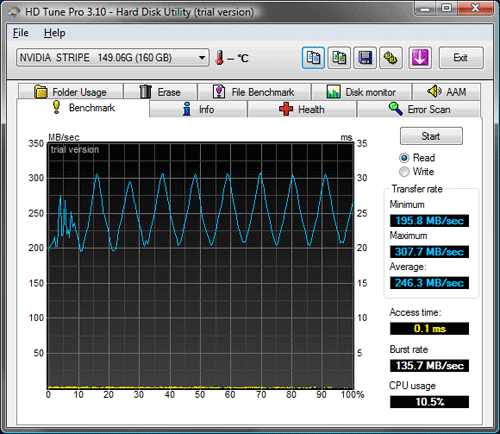
Though there is a pronounced saw-toothed performance pattern here, you can see that a pair of these drives offers, you guessed it, up to double the IO throughput of a single drive. For any standard SATA RAID 0 array we've tested to date, these are easily the fastest IOMeter numbers we've seen. Interestingly, our Sandra tests show the drives offer 396MB/s for read performance and 130MB/s write performance, while HD Tune and HD Tach show peaks and valleys from 200MB/s to 300MB/s. Regardless, we hope you enjoyed this quick-take performance test of what Intel's new SSDs can do in a performance-targeted RAID 0 setup. As always, with RAID 0, be sure to back up your data since you're effectively doubling your available failure points. Regardless, we're sure many of you have run RIAD 0 setups reliably for years now and there's no question a pair of Intel's X25M drives will make for a potent storage subsystem, especially as an OS volume.

Word is Intel's performance-tuned SLC drives are waiting in the wings too. So stay tuned here for our analysis as we get our hands on one of those beasts.

Original here

Apple sued for monopolizing the worldwide MP3 market

by Jim Dalrymple, Macworld.com

Taiwanese MP3 manufacturer Luxpro has filed a lawsuit against Apple claiming the Cupertino, Calif.-based company achieved its dominance in the MP3 market through monopolistic behavior.

Filed in the United States District Court Western District of Arkansas, Luxpro says in the lawsuit that “Apple has sought to stamp out the competition using various schemes” and “has repeatedly used unfair tactics against other smaller manufacturers.”

In 2005 Luxpro showed its newest product at the CeBit tradeshow in Germany. The “Super Shuffle” was a bit too much like Apple’s iPod shuffle and Apple applied for and won injunctive relief from a German court. Luxpro later renamed and relaunched the product under the Super Tangent name.

“Apple, as part of its scheme to squash a competitor, then sued Luxpro in Taiwan alleging that the appearance of the Super Tangent, EZ Tangent, and Top Tangent closely resembled the iPod shuffle,” the lawsuit reads. “Through a clearly one-sided submission by Apple when the lawsuit was filed, Apple was able to convince a Taiwanese court to enter a preliminary injunction that prohibited Luxpro from manufacturing, distributing and marketing any of its MP3 products.”

Even though Luxpro won the case on appeal, the company claims that “Apple’s unlawful legal strategy caused Luxpro to lose valuable market opportunities and a considerable amount of product orders.”

Luxpro also claims that Apple applied pressure to its business partners demanding they stop doing business with Luxpro.

Luxpro is seeking a jury trial and punitive damages “to punish the conduct of the Defendant and to deter others from similar conduct.”

This isn’t Luxpro’s first lawsuit against Apple. The company sued Apple in 2005 for $100 million claiming lost sales.

Original here

Due next from Apple: refreshed 20- and 24-inch iMacs

By AppleInsider Staff

Assuming last minute snags are avoided, the coming weeks should bring new iMacs, rounding out Apple's 2008 hardware introductions as the company enters the holiday shopping season with one of its strongest product portfolios ever.

Avid AppleInsider readers will notice that our little 2008 hardware roadmap -- published back in August and reprinted below -- has thus far panned out quite nicely, clearing the way for new iMac models to edge their way to market sometime in the next four weeks.

People familiar with the company's plans have said changes to the iMac family will largely consist of performance improvements and technology refreshes. And while there's admittedly been few concrete details to go by since the August report, this week's notebook overhauls offer a window into the future of the iMac line, which sports an architectural resemblance to the MacBook lines.

CPU

While the processors used in the existing iMacs largely resemble those of Intel's current Montevina-based offerings, they're actually a special run of the chipmaker's Santa Rosa-based offerings developed at Apple's request. They operate at high clock speeds and support a faster 1066MHz bus versus the 800MHz of the Santa Rosa-based parts that were available to the broader market at the time.

Since then, Intel has unleashed its Montevina (Centrino 2) platform, which umbrellas new Core 2 Duos that are shipping inside the new unibody MacBooks, and are destined for the fall iMac line at clock speeds close to those currently available.

Intel has also been working diligently on quad-core mobile chips that should eventually find their way into iMacs, especially around next year's release of Snow Leopard; the operating system will include Grand Central technology designed to leverage Macs with an increasing number of processor cores.

As it stands, the chipmaker currently offers a quad-core 2.53GHz Core 2 Extreme mobile processor that sports a similar thermal envelope to the special run 3.06GHz Core 2 Duo employed by the existing top-of-the-line iMac. With its $1000+ price tag, however, Apple may be hesitant to use the chip even if there doesn't appear to be anything else stopping the firm from adopting the chip this year for a high-end iMac.

Original here