Followers

Wednesday, July 30, 2008

Google's Android platform: not so open after all

By Ryan Paul

Google vowed that its Linux-based Android mobile platform would empower enthusiasts and amateur developers, but today we have seen compelling evidence that this is an empty promise. Third-party Android application developers, who have grown increasingly frustrated with the lack of SDK updates, were shocked to discover that Google has been secretly making new versions of the Android SDK available to the Android Developer Challenge (ADC) finalists under non-disclosure agreements.

This was revealed yesterday when Google employee David McLaughlin accidentally sent notification of a new SDK release to a public Android mailing list. The message, which was intended only for ADC Round two entrants, says that SDK build 84853 is available through the private ADC download site. McLaughlin later apologized for mistakenly sending the message to the wrong list. ADC Round two participants have confirmed that they have access to updated SDK builds but declined to provide further details because they are bound by non-disclosure agreements. We have contacted Google and asked for additional details, but we have not yet received a response.

While most of the Android community was forced to use an outdated version of the SDK from February and were left to wonder if they would ever see another SDK release at all, a small assortment of 50 gagged developers were given priority access to much-needed improvements and bug fixes that Google has apparently been keeping secret. This revelation has compelled some to question the search giant's motives and wonder whether Google is really committed to making Android an equal-opportunity platform for enthusiast developers. For many of the critics, Google's secrecy and unwillingness to communicate is ultimately more troubling than the lack of SDK updates.

"I don't think the biggest issue here is who has and doesn't have access to the SDK. I think the main issue here is communication or lack thereof. Google embraced the development community and touted how they were going to build this platform with the help of the development community. Somewhere along the line, this 'seemed' to change. I say seemed because this could have always been part of Google's strategy," wrote third-party developer Ken Adair in a message to the Android discussion list. "The problem is they have failed to nurture the relationship with the development community. They have cut them off from the information that was once flowing and left them to speculate and wonder. In response, you are seeing many that feel cheated and betrayed."

Non-disclosure agreements and selective access to development tools are hardly emblematic of an open ecosystem. Google has intentionally disadvantaged many developers and kept the broader Android community in the dark about the progress of the platform. Google's failure to fulfill its commitment to openness has eroded one of the principle differentiating factors that made Android a relevant alternative to Apple's iPhone operating system. If Google cannot change course, the lack of transparency in the development process will likely push disenfranchised developers towards other mobile platforms.

Original here

More than you ever wanted to know about Microsoft

Getting one of Microsoft's top managers to talk is achievement, but getting them all together in one room can mean only one thing: it's Microsoft's annual Financial Analysts Meeting (FAM). This is attended in the flesh by people from Merrill Lynch, JP Morgan, Credit Suisse and so on, or virtually via streaming on Microsoft Investor Relations Web. And, of course, anyone can read the transcripts and download the slides afterwards.

Since Steve Ballmer's talk alone runs to more than 15,000 words, this is not a trivial undertaking. Also, the vast majority of Microsoft's $60 billion revenue comes from business software, which (apart from Windows and Office) may be of little or no interest to consumers, even if they have heard of it. An alternative is to read Mary-Jo Foley's reports at All About Microsoft for some of the highlights.

Naturally there was some talk of how Microsoft can change some people's perception of Vista -- which has now sold 180 million copies -- to match the reality. Bill Veghte from the Windows group showed a video where people who didn't like Vista were invited to try a new operating system called Mojave. As Foley notes:

The participants, a number of whom admitted they had no direct hands-on experience with Vista, said they were jazzed about Mojave and would definitely use it once it was released.


It was, of course, Vista.

Some of Vista's problems have been created by PC manufacturers shipping mediocre, crapware-infested installations, which they have every right to do, but Microsoft is trying to do something about it. Veghte said:

The final piece of it is what we do with our PC partners, whether that be HP or Dell or Sony or the many others that are a key part of the Windows ecosystem. We worked subsequent to general availability, we worked with each one of these vendors to do what we called the Windows Vista Velocity Program. And think of this as running a set of those systems and the entire software load that they have on them through a very extensive set of tests to measure everything from reliability to security to compatibility, boot time, et cetera. We ran over 280 systems through that process and you're starting to see the results of that in the market today.


In response to a question from the floor, Steve Ballmer rambled around the same topic, saying:

You can take the same laptop, oftentimes, and pre-configure it one way and you get almost instantaneous boot, and fantastic battery life. If you pre-configure it with software in another way you get long boots, and much less battery life. That kind of education, discussion, dialogue we find our OEMs appreciate. It doesn't mean they always follow our advice, and we certainly respect their right, under our consent decree and everything else, to preload any software they want to on those machines. But, we're trying to at least help people understand the opportunity to not only offer fantastic choice, low prices, different margins, but also some of our OEMs, I know, are going to step up and do a lot more to complete the end-to-end experience, software, hardware, et cetera. And that will be a great thing.


Microsoft has already put a lot of effort into tackling the software compatibility and driver issues. And as we've already noted, it has a new agency working on some new advertising.

Update: Microsoft plans to put some "Mojave Experiment" video online here.

Original here

KDE 4.1 rocks the desktop

By Jeremy LaCroix

KDE 4.1 was finally released to the public today. After all the controversy since the release of KDE 4.0, I'm happy to announce that KDE 4.1 simply rocks.

KDE 4.1 packages are available for Kubuntu and several other popular distributions. If there are no prebuilt binaries yet for your distro of choice, you can compile the software from the available source packages. A live CD image is also available should you wish to try the new desktop without altering your existing installation.

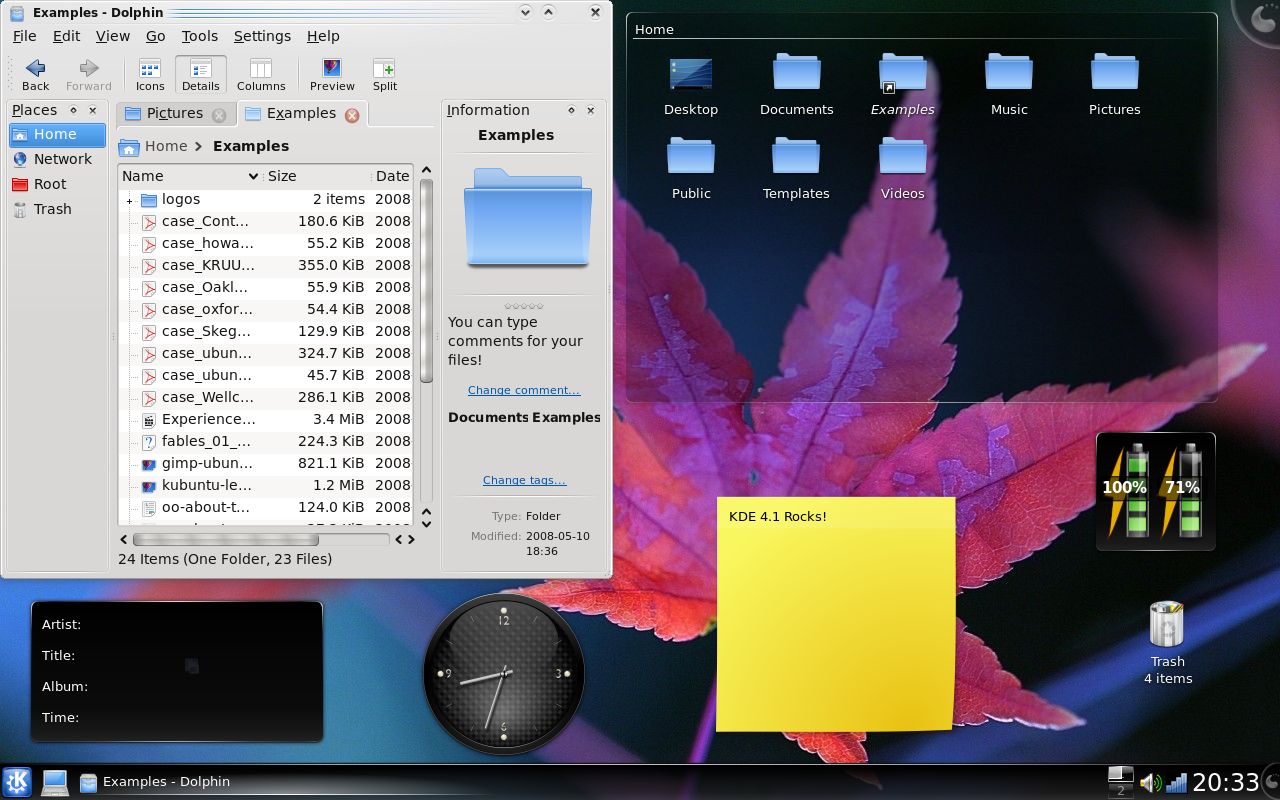
The introduction of KDE 4 marked the introduction of the new Plasma desktop, which provides not only the panel that you interact with, but also widgets (or "plasmoids") that extended the desktop further. In KDE 4.1, one of the most welcome changes to Plasma is the return of multiple and resizable panels from KDE 3. Now you can configure your panels by clicking on the Plasma icon (by default it's on the right edge of the panel), which brings up a series of sliders for adjusting the panel's height and position. Also within this configuration control is the return of a way to reposition panel contents by simply grabbing objects with your mouse and pulling them to where you'd like them.

One of the most controversial announcements during the KDE 4.1 development cycle was the reported removal of icons for the desktop. In actuality, desktop icons are not missing from the new version, they're just handled differently. This version introduces a Folder View plasmoid, which is a container you can place on the desktop that can show the contents of any directory. Most distributions set one up in the default configuration to show the contents of the desktop folder, but you are no longer limited to having the contents of just the desktop folder displayed on your desktop -- you can add several instances of Folder View, each showing a different directory.

Click to enlarge

As far as eye candy, KDE 4.1 looks simply stunning. While its theme uses the same foundation as 4.0, the developers have improved it with many tweaks. Desktop plasmoids no longer have extremely thick borders, transparent objects appear cleaner, the KDE login manager and splash screens have a new theme, and a tweaked version of the Oxygen window border (called Ozone) is included and better blends into the styles. Plasma itself has also been given its own theme engine (separate from the KDE desktop theme) with several different themes already built in.

The default application roster contains the same lineup as before, with Konqueror as the default Web browser, Dolphin for file management, Gwenview handling image viewing, Kopete taking care of instant messaging, and JuK managing audio playlists. Although Konqueror doesn't seem to offer the same level of functionality (such as the number of available plugins) that Firefox and Opera do, it's still a solid app. Returning from KDE 3 for the first time in the KDE 4 cycle is Kontact and its related personal information management tools, as well as the KDE CD Player.

Some of the most notable new features in KDE 4.1 include the introduction of the minimalistic Dragon Player for videos, tree view and tabbed browsing features in Dolphin, and several improvements in Gwenview, such as a thumbnail bar and the repositioning of the rotate and full screen options to easier to reach places to minimize mouse movement.

With all of the new features, one might think the responsiveness of the KDE desktop would take a hit. In my tests, everything ran fast and smooth, even when I had six plasmoids in use and desktop effects turned on, even on a modest 1.6GHz laptop.

On the down side...

Not all of the improvements are clear winners. The new interfaces may take some getting used to by those accustomed to KDE 3. In addition, users with Nvidia graphics cards and proprietary drivers may notice slowdown when resizing windows or moving plasma widgets, although I did not experienced this during tests with my Nvidia hardware.

Finally, users are likely to miss Amarok 2.0 (at the time of this writing it's not yet completed) and a KDE 4 version of KnetworkManager.

KDE marks a triumphant return to full usability with the 4.1 release. I've read that some KDE 3 features still need to be ported to KDE 4, yet I'm hard pressed to think of anything missing, except for a way of hiding the panel. The developers have done a wonderful job of keeping their promises of a return to glory for KDE. This new release has become the default desktop on several machines in my house, replacing KDE 3 completely.

Jeremy LaCroix is an IT technician who writes in his free time.

Original here